Drama Color Pattern Analysis

Analyzing how Korean drama color grading affects viewer preferences through a cross-cultural comparison of Money Heist and its Korean remake.

Timeline 2024 – 2025
Role First Author
Research Design & Data Analysis
Advisor Hoyoung Yoon
Ewha Womans University
Published — Journal of the Korean Data Analysis Society, Feb 2025

Color grading is a defining visual element of Korean dramas, yet previous research had two blind spots: studies either compared color differences between dramas without connecting them to viewer preferences, or measured preferences using artificially manipulated colors detached from real content.

This study bridges both approaches. By cross-applying the actual color properties from the Spanish original Money Heist (La Casa de Papel) and its Korean remake Money Heist: Joint Economic Area, we tested whether viewers prefer Korean color grading — and whether that preference stems from the colors themselves or from personal attributes like nationality.
1.5×
Korean color grading preferred over Spanish original
T-test, p = 0.046
86
Valid survey responses across three nationality groups
Korean 40 · Chinese 32 · Other 15
20
Image pairs analyzed — character and background scenes
10 pairs × 2 color versions

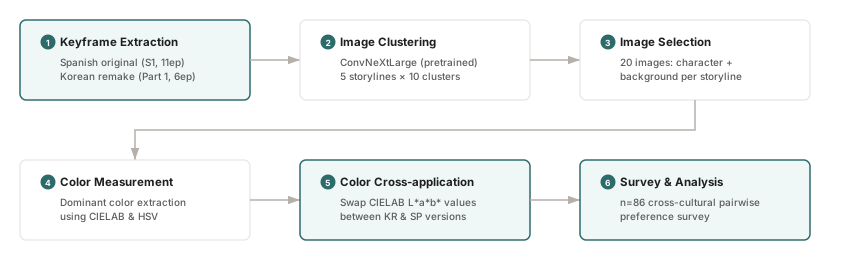
The core challenge was creating a fair comparison: how do you isolate the effect of color grading from everything else in a scene? We designed a six-stage pipeline that extracts, measures, and cross-applies color properties between the two versions of the same drama.

1

Keyframe Extraction

Extracted keyframes from the Spanish original (Season 1, 11 episodes) and Korean remake (Part 1, 6 episodes). Removed duplicate compositions via image vector comparison to retain only unique scenes.

2

Image Clustering

Used ConvNeXtLarge (ImageNet-pretrained) to cluster frames by visual similarity across 5 aligned storylines, producing 10 clusters each. This groups scenes by visual features rather than captions or metadata.

3

Image Selection

Selected 1 character scene and 1 background scene per storyline — 20 images total. Excluded violent or shooting scenes for ethical compliance. Character and background images were separated because prior research shows color functions differently for each.

4

Color Measurement

Extracted dominant colors from each image using CIELAB and HSV color spaces, capturing both perceptual color differences and saturation/brightness characteristics.

5

Color Cross-application

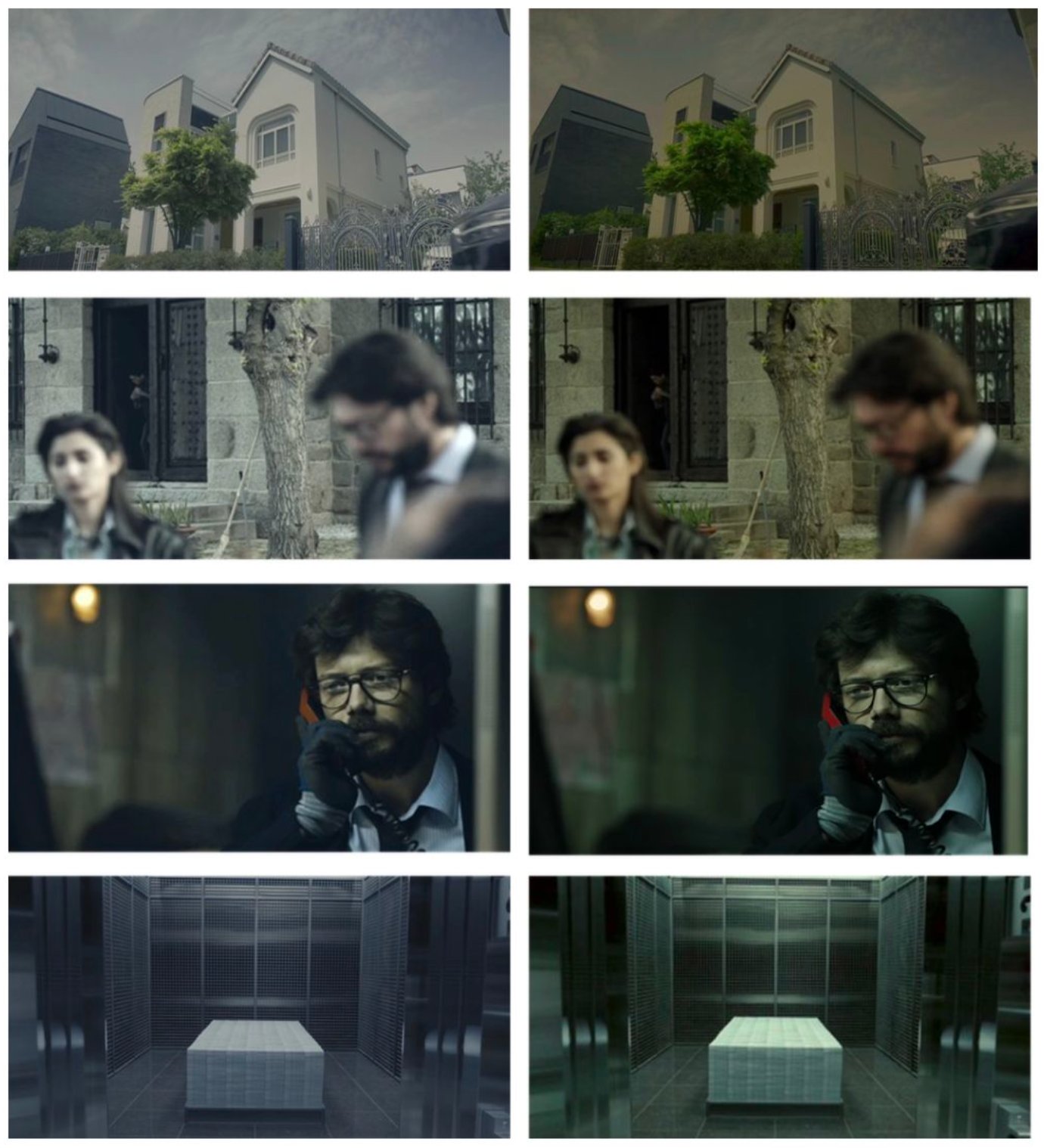
Applied CIELAB L*a*b values from each drama's color profile onto the other version's images. This means the same scene appears with both Korean and Spanish color grading — isolating color as the only variable.

6

Survey & Analysis

Surveyed 86 participants (Korean, Chinese, and other nationalities) on pairwise color preferences, controlling for OTT subscriptions, prior viewing of both versions, and nationality.

Six-stage methodology pipeline: Keyframe Extraction, Image Clustering, Image Selection, Color Measurement, Color Cross-application, and Survey & Analysis
Research pipeline: from keyframe extraction to cross-cultural preference survey.
Color comparison between Korean remake and Spanish original versions of Money Heist, showing the same scenes with different color grading applied
Survey image examples: Korean remake color (left) vs. Spanish original color (right), cross-applied to the same source images.

Design rationale: Unlike previous studies that artificially shifted RGB values, we cross-applied actual color measurements from each drama using CIELAB coordinates. This preserves the authentic color palette that viewers experience, and ConvNeXtLarge clustering ensures visually comparable image pairs.

Methods & Tools
ConvNeXtLarge CIELAB HSV Analysis K-means Clustering Logistic Regression Random Forest User Survey (n=86)
01

Korean color grading preferred 1.5×

Across the full sample, images with Korean drama colors were preferred at 52.5% versus 39.7% for Spanish original colors (p<.05). This held regardless of whether the source image came from the Korean or Spanish version — color grading, not content familiarity, drove preference.

02

Color properties, not personal taste

Logit analysis showed that personal attributes — nationality, number of OTT subscriptions, whether participants had watched either version — did not consistently predict color preference. The preference was driven by the color properties of the images themselves.

03

Saturation-based harmony is the key differentiator

Korean drama colors are characterized not by high contrast between light and dark, but by saturation-based harmony — colors with similar chroma levels placed together. This finding is consistent with prior Korean-Japanese drama comparisons, suggesting a generalizable pattern in K-content color design.

View Abstract → Download PDF →

Color preferences are not subjective noise — they are measurable responses to specific visual properties. Quantifying these patterns enables data-driven visual content optimization at scale.

This study quantified something that content platforms and media companies have long relied on intuition for: how color composition affects viewer engagement. The finding that saturation harmony — not contrast or brightness — drives preference has direct applications in automated color grading pipelines, content recommendation systems, and A/B testing visual assets.

The methodology itself — combining deep learning-based scene clustering with color space analysis and statistical validation — demonstrates a reusable pipeline for any domain that needs to extract and evaluate visual features from large media datasets. This is the kind of computational analysis that turns subjective creative decisions into data-driven optimization.

Back to All Projects